Our impact in 2025
With breakthroughs in accessibility and huge project milestones reached, 2025 has been full of achievements for the Micro:bit Educational Foundation and our community.
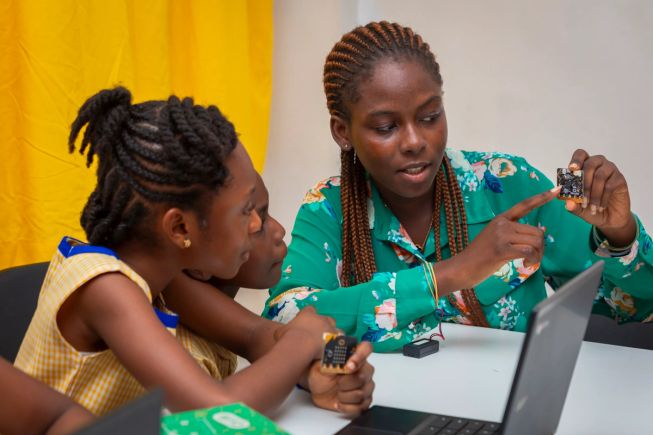
As well as developing their coding skills, our work continues to expand children's digital and data literacy around the world. This access to core digital skills is becoming even more important, as artificial intelligence becomes more and more prominent in our day-to-day lives.
Projects such as BBC micro:bit – the next gen in the UK, our project with Los Angeles County Office of Education (LACOE) in the US, and our global projects with UNICEF have demonstrated the effectiveness of micro:bit. Educators consistently report an increase in their own confidence in teaching computing, and an increase in student engagement and enjoyment. Read on to find out more.
Our impact
So far, in total (since 2016)
- 70 millionyoung people have benefitted from learning with the micro:bit
- 11.5 million micro:bits have been distributed
- 85+countries using micro:bit
In 2025
- 3.7 million active users across microbit.org, Python editor and micro:bit classroom
- 75 millionblocks coded every month on Microsoft MakeCode
- 120+partner organisations that we're working with globally
- 383 micro:bit Champions across 51 countries
Between September 2024 - August 2025
Broadening reach:
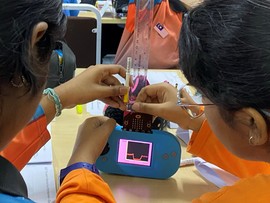
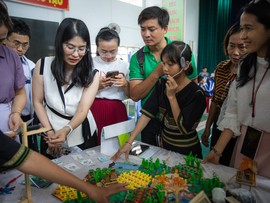
- Teachers in about 60 schools across Viet Nam, Honduras, Montenegro and the Maldives implemented their training in using micro:bit and design thinking to support the teaching of 21st century skills (Tinkering with Tech project with UNICEF)
- Elementary educators from across 90+ schools in Los Angeles County participated in professional development to integrate CS into their teaching using micro:bit (LA county project preliminary data, full report in 2026)
- 280 different extensions were used monthly on Microsoft MakeCode (extensions add new blocks or capabilities to MakeCode, for example to broaden learning, or support different hardware add-ons and integrations)
Increasing educator awareness and motivation:
- Teachers in the UK felt that micro:bit was a resource that encouraged creativity. They felt that it had a wide range of possibilities, that its tangibility and physical nature allowed the pupils to see their creations, and that it had the ‘wow factor' (EPICS, University of Cambridge)
- 89% of teachers agreed that the teaching content was relevant to their broader teaching practice (Tinkering with Tech project with UNICEF)
- Following training, 96% of educators agreed or strongly agreed with the statement “I am excited to integrate CS into my classes or lessons.” (LA county project preliminary data, full report in 2026)
Reaching more under-represented children:
- 81% of girls taught with micro:bit agreed they'd like a job linked to coding, compared with just 37% of those who hadn’t been taught with micro:bit (the next gen, UK, Platypus 2025)
- 78% of teachers agreed that there is something in particular about micro:bit lessons that really engages their SEND students (the next gen, UK, Platypus 2025)
This year, our work has been recognised through many prestigious awards:
- Anthem Awards: Gold Winner in Responsible Technology: Education or Literacy Program or Platform (for the Micro:bit Educational Foundation)
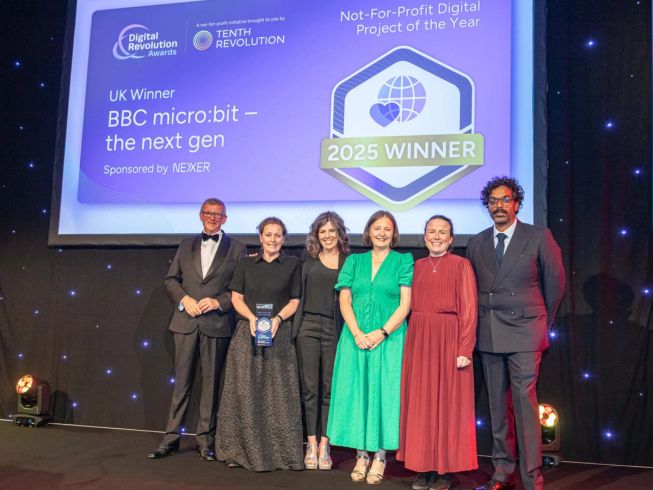
- Digital Revolution Award: Not-For-Profit Digital Project of the Year Award at the Digital Revolution Awards 2025 (for BBC micro:bit - the next gen)
- Blockly Partnership Award: Lucy Gill (Head of Product), for our work on Blockly accessibility
- Our colleagues at Lancaster University were recognised for their amazing contributions to the micro:bit hardware – Professor Steve Hodges was awarded the IET Mountbatten Medal, and Lancaster University was awarded the Queen Elizabeth Prize for Education.
Our work
Global impact
Working with partners around the world, we have been supporting projects to extend our impact.
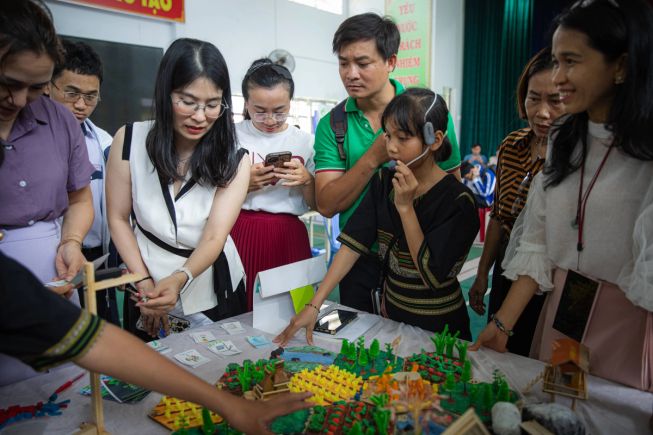
As an implementation arm in the Tinkering with Tech programme, powered by the UNICEF Global Learning Innovation Hub, we have worked closely with UNICEF country offices in Honduras, Montenegro, the Maldives, and Viet Nam, continuing to transform learning by bring design thinking to STEM teaching.
With support from Microsoft, Future Farmers of America (FFA) has distributed micro:bit FarmBeats for Students kits for free to local FFA chapters across all 50 states in the US to inspire their students with exciting possibilities at the intersection of technology, agriculture, and sustainability.
As part of the Google Blockly Accessibility Fund, this year we have made great progress on our accessibility work. We launched accessibility guidance for teachers, giving practical tips for using micro:bit with students who have disabilities. In collaboration with Blockly and Microsoft MakeCode, now block-based coding in Microsoft MakeCode for micro:bit can be used with keyboard navigation. We continue our research with users to develop further updates and improvements.
Community expertise
Our partnerships in local and specific contexts enable us to support further expansion and sharing of that expertise.
Our learnings last year in Compton helped us develop a project across California, USA, by supporting LACOE in their innovative work to integrate computer science across the curriculum.
Core activities in the BBC micro:bit – the next gen campaign came to a close, in which over 90% of primary schools in the UK received micro:bits, and research findings show high levels of impact, and we will continue to work with partners to build on the initiative’s legacy.
We have also been able to work with grassroots partners to galvanise expertise and build momentum, through events such as micro:bit Live in Virginia and California, and the amazing work of the micro:bit Champions network, our volunteer translators, and participants in the do your :bit challenge.
Educational resources
As well as delivering educational resources through specific partnerships and projects, we have also continued to add to our freely-available content on our website. From our Make it: code it projects, to CreateAI resources, to cross-curricular topics such as data measuring and science, you can find a range of inclusive content for micro:bit.
- CreateAI taster lessons
- AI sports data logger
- AI projects
- Data measuring poster
- Science investigations with White Rose
Thank you!
We have been able to deliver impact at this global scale thanks to the support of a wide range of partners. In particular, we are grateful for the support provided by the following organisations, without which many of these projects and activities would not have been possible:
- Amazon
- Arm
- British Council
- Nominet
- Nordic
- UNICEF

This year Universiti Teknikal Malaysia Melaka reached 1,600 participants from 368 schools across Malaysia — through both physical and virtual sessions. One of the most exciting parts was introducing the Create AI platform, which sparked great interest and curiosity among students. It was inspiring to see their enthusiasm as they explored AI in a fun, hands-on way!

At micro:bit Live in the USA, we did not just explore technology. We saw how computer science becomes a bridge between subjects, ignites creativity, and builds community. When educators, innovators, and learners come together, we unlock new possibilities for every student to shape their digital future.
Rudy Escobar, STEM and Computer Science Coordinator, Stanislaus County Office of Education/CSforCA Co-Chair
Micro:bit Educational Foundation is one of the most impactful organisations in digital education today. The team’s commitment to working with partners around the world to give young people the opportunity to learn to code, is both inspiring and vital. micro:bit makes digital skills accessible, practical and fun by empowering teachers and students alike. They are helping to build the next generation of problem-solvers, innovators and digital citizens and I’m so proud to support the team.
Lisa Opie, Board member, Micro:bit Educational Foundation, Portfolio Non Executive Director and Media Consultant
What’s next?
2026 is the 10-year anniversary of the Micro:bit Educational Foundation. We are excited to celebrate the amazing progress, learnings and development of the wonderful micro:bit community so far.
We also look forward to the future, where we must ensure that every young person is able to make the best of technological innovations, such as artificial intelligence.
We kick off 2026 with micro:bit Live Global in Barcelona on 27 – 28 February, as we bring together our community for a global, in-person event for the first time in seven years. There we will showcase incredible work and from across the micro:bit community, hear insights from notable leaders in computing science, as well as share updates from the Foundation, so make sure you register now.